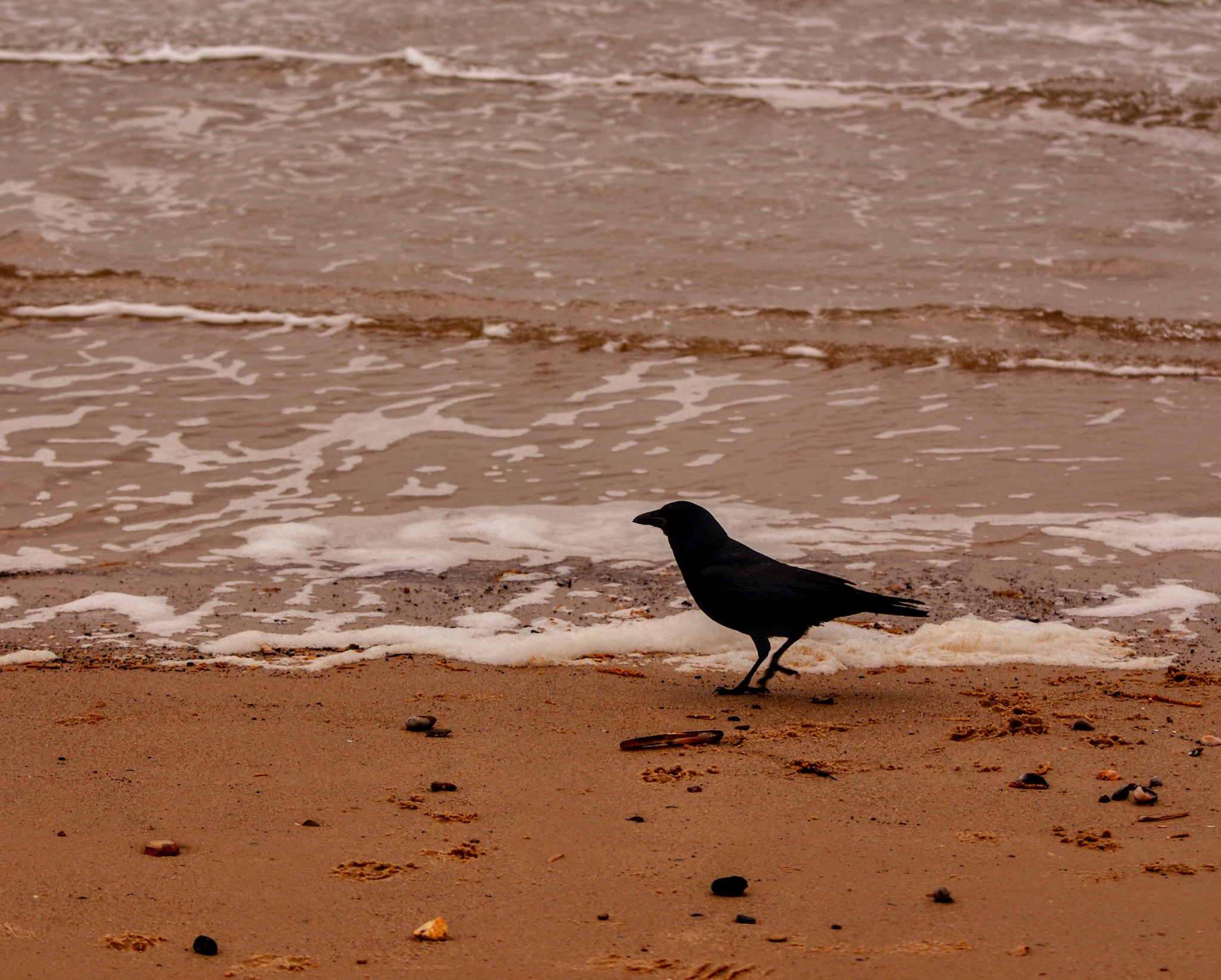
Photograph: Robin K Hickson
Story · Folklore · East Anglia
Black Shuck becomes legend
A black dog entered two churches during a storm in 1577. Four and a half centuries later, it has acquired a name, a territory and a biography.
The useful place to begin is not with Black Shuck. It is with a cheap printed pamphlet, published in London in 1577 and written by the clergyman Abraham Fleming.
Fleming described a storm over Bungay in Suffolk. During Sunday service, thunder and darkness overwhelmed the church. A ‘black dog’ appeared among the congregation, ran between two people and killed them. Another man was left scorched and drawn together. The creature then appeared at Blythburgh, where more people died and the church fabric was damaged.
The pamphlet treats the event as divine warning. It does not offer a modern ghost story, a coastal mascot or an antiquarian field guide. Its dog is one element in an account of thunder, fire, death and judgement.
There is a black dog in the early account. The fully furnished Black Shuck comes later.
Placed traces
Three versions of the ground
Folklore gains authority by attaching itself to doors, scorch marks, lanes and named stretches of coast. The place survives; the explanation hardens around it.
- 01
Suffolk
Bungay
On Sunday 4 August 1577, during a violent storm, a black dog was said to run through St Mary’s Church. The contemporary pamphlet blamed the deaths of two worshippers and the burning of another on its passage.
- 02
Suffolk
Blythburgh
The same account then carries the creature roughly twelve miles to Holy Trinity Church, where the storm, the dog and further deaths become part of one continuous prodigy.
- 03
Norfolk
The Norfolk coast
Later retellings spread the dog northwards and outwards: along lanes, churchyards, dunes and sea walls. Here the named figure of Black Shuck becomes larger than the 1577 report that is now used to authenticate him.
The later animal
A legend assembled backwards
Today’s Black Shuck is usually enormous, black, shaggy and equipped with one or two blazing eyes. Meeting him may predict death, cause death or merely ruin an evening. The details vary because there is no single canonical beast.
The name is commonly connected with an old word for a shaggy dog, but the historical trail is less tidy than the confident summaries suggest. East Anglia had many black-dog traditions. Over time, local apparitions, the 1577 church account and later literary retellings were drawn together under one memorable name.
That process is the story. Black Shuck is not simply an ancient legend preserved intact. He is a successful act of cultural consolidation: scattered dogs, old fears and specific buildings made to look as though they had always belonged to one creature.
Fieldwork proposition
Walk the evidence, not the souvenir.
The Norfolk fieldwork will follow the legend by location and date: what was recorded, what can still be seen, what was added later, and why a black dog remains such an efficient shape for fear at the edge of land.
Continue to the Norfolk fieldworkWorking sources
- Abraham Fleming, A Straunge and Terrible Wunder (1577), the printed account of the events at Bungay and Blythburgh.
- St Mary’s Church, Bungay, and Holy Trinity Church, Blythburgh: the two buildings named in the account.
- Later East Anglian black-dog collections and retellings, treated as evidence of the legend’s development rather than proof of the 1577 event.
This is an editorial foundation page. Quotations, archival links, mapped locations and field photographs will be added as the Norfolk research is completed.